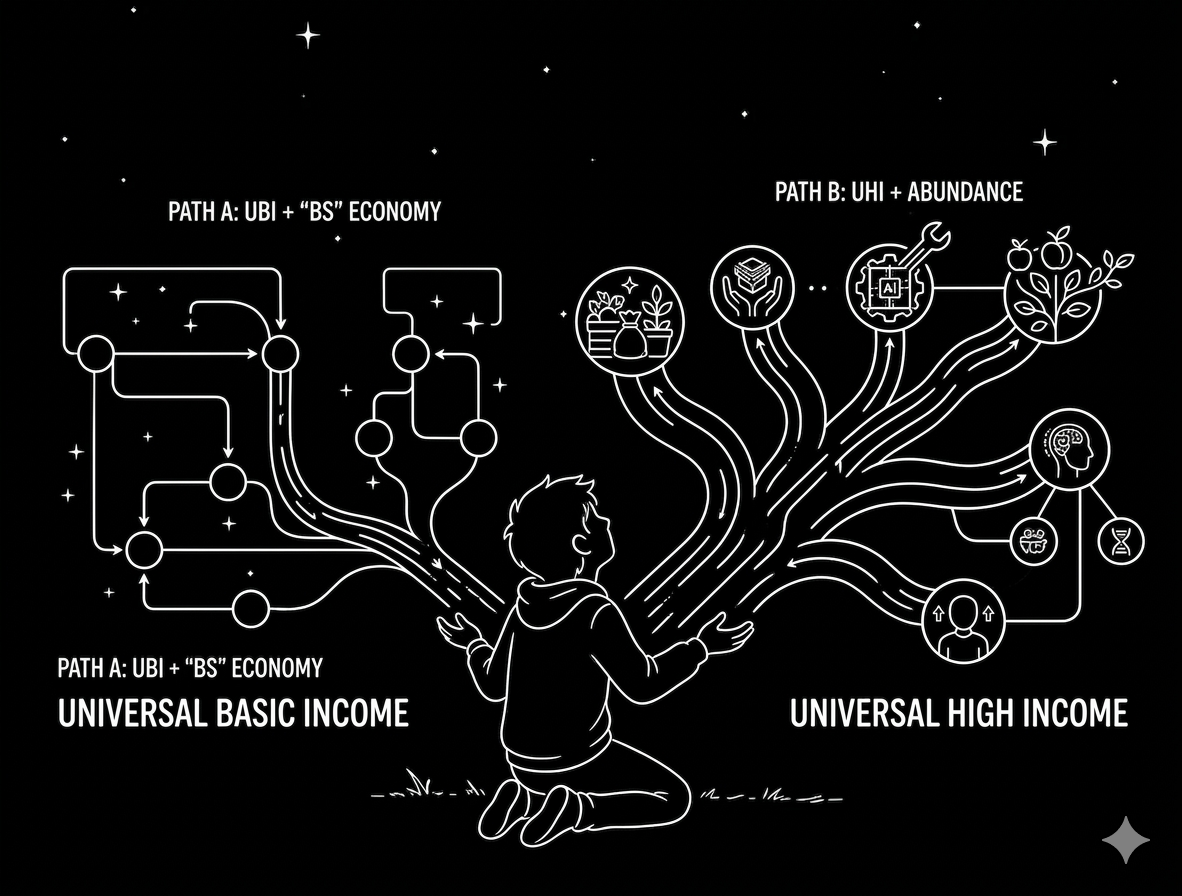
If you think AI will give you Universal Basic Income, or Universal High Income, you might be very naive.
I get that there's no obvious way this will develop, but we can look at history and see how transformational resources have affected populations and their income.
When a country discovers highly valuable natural resources — oil, gold, diamonds, rare earth elements — the government becomes less dependent on broad-based taxation and increasingly reliant on resource extraction instead. Once that happens, the population becomes less economically necessary to the state.
A government is far more responsive to its people when it needs their tax money to survive. When it doesn't, citizens stop being stakeholders and start being a cost. This is not theory. We've seen this repeatedly.
Sudan has abundant gold. The state doesn't need broad prosperity, just control of the mines. The population becomes an inconvenience. Venezuela relied almost entirely on oil. Once oil revenue replaced taxation as the primary source of state funding, accountability collapsed. Citizens could protest, but the state no longer depended on them. The same pattern appears in Nigeria (oil), Angola (oil), the DRC (minerals), Equatorial Guinea (oil), and even Russia (oil and gas). This isn't about corruption — it's structural.
Now replace "oil" with AI and automation — not as a physical resource, but as a concentrated, non-labor source of productivity.
If AI takes your job, the means of production are no longer performed by citizens. Corporations can generate massive profits with minimal human labor. Robots don't strike. Models don't unionize. Servers don't vote. At that point, labor is no longer the primary bottleneck or source of bargaining power. Capital and compute are. Citizens will start demanding services and income support. But someone who doesn't work doesn't pay income tax — the most direct and politically visible link between citizens and the state. And a government that is no longer dependent on income tax has weaker incentives to represent them. The population becomes an inconvenience.
UBI or UHI would require taking money from corporations and redistributing it to people who no longer participate directly in production. Do you really think this will happen at scale, voluntarily, and sustainably?
Right now, over 10% of Americans are classified as poor. Support exists, but it's calibrated to be barely enough to survive, intentionally so. Enough to prevent collapse. Not enough to create leverage. That's today, when labor is still economically necessary.
What happens when labor becomes optional?
History suggests the outcome won't be generous redistribution. It will be containment. Minimal support. Just enough stability to keep the system running. People imagine AI as a benevolent oil well that funds society. History says resource wealth concentrates power, reduces accountability, and makes people expendable — unless they remain economically necessary. There are exceptions, but they require unusually strong institutions. You will say that America has a strong democracy and strong institutions, but right now those institutions are eroding.
Democracy is the only thing that forces governments to remain dependent on people rather than capital. It keeps taxation, representation, and legitimacy tied together. Break that link, and the incentive structure flips.
What's worrying isn't AI by itself, but AI arriving while democracy is already eroding:
- voter suppression and disengagement
- money dominating politics
- executive power expanding
- institutions losing trust
In a strong democracy, automation could be negotiated: taxation of capital, antitrust enforcement, redistribution with teeth. In a weak one, it won't be. Power will consolidate where productivity lives — corporations, compute, capital.
You could argue that when similar technological shifts happened in the past, labor was displaced into other jobs. At the beginning of the last century, about 40% of people in the U.S. worked in farming or were closely tied to it. Today that number is around 1–2%, and the economy ultimately absorbed the displacement. In that case, machinery, automation, and technology caused displacement, not replacement.
With AI, it could be different. There is a lot of talk about replacement. I don't know what will happen, but maybe it will replace a portion of the workload, at least temporarily. Even if 10% to 20% of jobs are replaced quickly, society is unlikely to have time to make significant institutional adjustments to provide UBI to the unemployed.
This is not about evil governments or bad intentions. It's about incentives, and history is very clear about how incentives play out. Massive unemployment will not automatically lead to UBI.
I am not pretending to see the future, but from what we see in the news, and factoring in historical data, we should be concerned about a technology that can replace labor across a vast array of fields, quickly. This is what many are expecting. I hope they are wrong. I hope I am wrong.
Throughout history, when large segments of the population stop being economically necessary, their political relevance consistently erodes. The obvious solution would be to strengthen democratic institutions, but we are doing exactly the opposite.
— Tomás Ryan